Game Day Rental Income in Auburn, AL: What the Data Shows
Game Day Rental Income in Auburn, AL: What the Data Shows
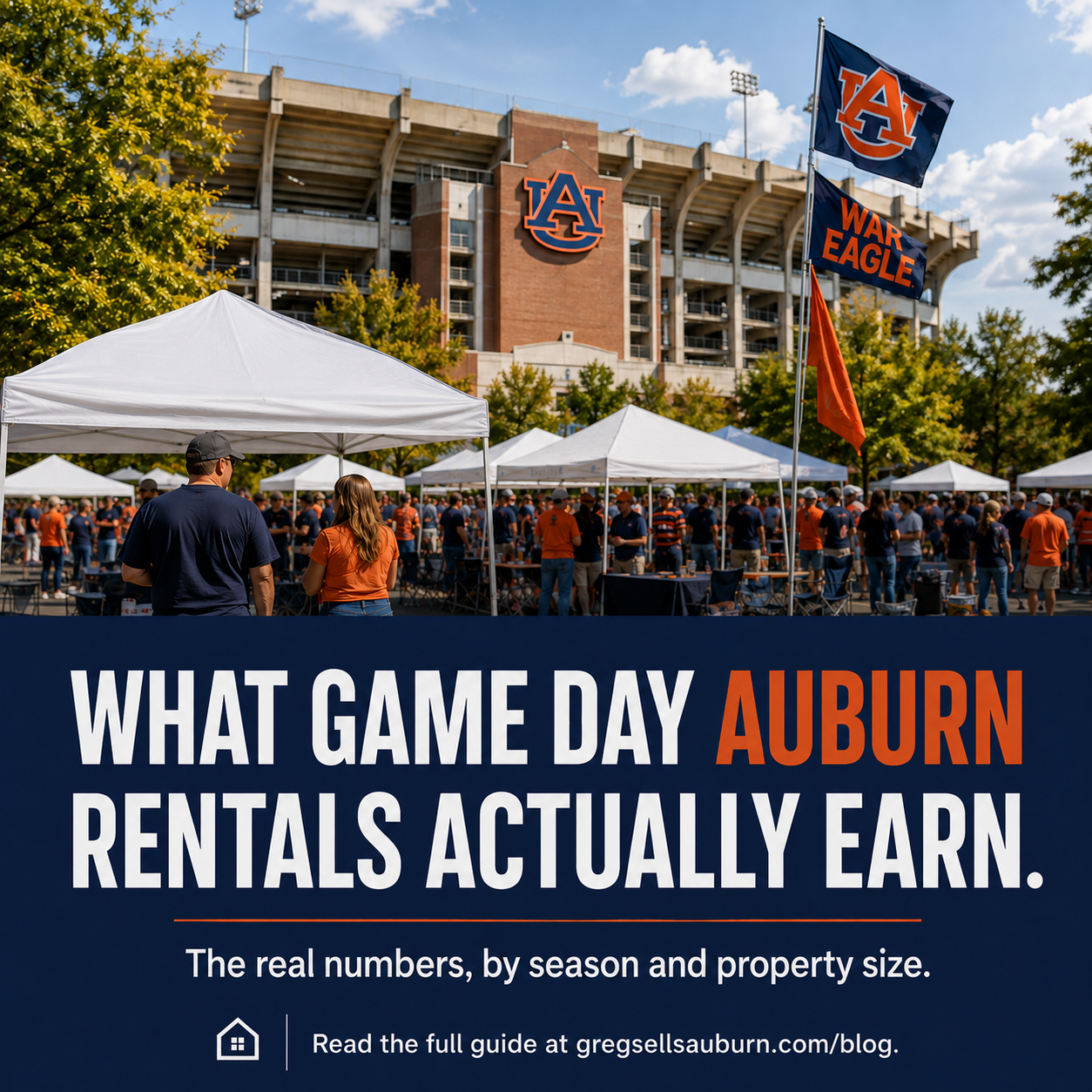
If you're looking at a short-term rental purchase near Auburn University, you've probably seen the pitch: buy a place, rent it out on football weekends, and let the SEC schedule do the heavy lifting. The real numbers are more nuanced than that. Here's what the data actually shows, and what it means for someone evaluating a game day property right now.
It also helps to understand why people buy these properties in the first place. Not everyone is chasing pure rental income. A lot of buyers want a place they can use themselves for home games and other Auburn trips (avoiding hotel prices and the hassle of booking one every time they visit the Plains), then rent it out the rest of the time to help cover the mortgage. That's a legitimate strategy, but it changes the math: the weekends you keep for yourself are usually the same weekends that would otherwise bring in the highest rental income.
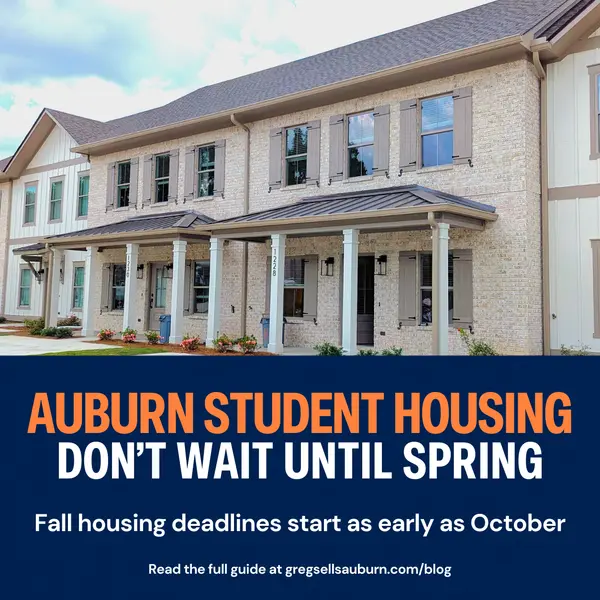
If you have a student at Auburn now, this can also work in reverse. Once they graduate, some parents look at converting their condo or townhome into a short-term rental instead of selling. It's worth doing with clear eyes: a property earning steady income from a full-time student lease will almost always out-earn the same unit run as a game-day-only Airbnb, since you're trading twelve months of occupancy for a handful of high-value weekends.
The Annual Averages (and Why They're Misleading on Their Own)
Two of the more widely used short-term rental analytics platforms track Auburn separately, and they don't agree with each other, which is worth understanding before you lean on either one.
Rabbu's data (as of late April 2026) shows 208 active Airbnb listings in Auburn, an average daily rate of $216, 23% average occupancy, and average annual revenue of $27,456.
AirDNA's data (updated August 2026) shows a larger pool of 759 active listings across Airbnb, Vrbo, and Booking.com, a $369 average daily rate, 35% occupancy, and average annual revenue of $21,100. AirDNA also notes that Auburn's revenue, occupancy, and ADR are all down year over year, while the number of active listings is up nearly 8%, a sign that supply is growing faster than demand right now.
Why the gap? Different platforms track different listing sets, use different comp methodologies, and weight property types differently. The practical lesson: treat any single "average" you see quoted for Auburn as a soft number, not a hard fact. What matters more is the shape of the data: both platforms agree Auburn is a seasonal, event-driven market with an average that blends a handful of very strong weekends against a lot of quiet ones.
Why the Annual Average Undersells Game Weekends
An annual average includes non-football months. Rabbu's month-by-month revenue breakdown makes the seasonality clear: September averages $4,298 in revenue and November averages $4,535 (prime football months), while January drops to just $1,078. That's roughly a four-to-one spread between Auburn's best and worst months, and the strong months line up directly with football season.
In my experience working with buyers in this market, home game weekends, graduation weekends, and other high-demand Auburn University dates can easily push nightly rates to two or three times what a property earns on a typical weekend. That's a professional observation based on what I see in this market, not a published statistic, so build your own projections conservatively and confirm current pricing trends with a property manager or STR platform before you buy.
For 2026, Auburn has six home games at Jordan-Hare Stadium: Southern Miss (Sept. 12), Florida (Sept. 19), Vanderbilt (Sept. 26), LSU (Oct. 24), Arkansas (Nov. 7), and Samford (Nov. 21). Add graduation weekends (typically May and December) and you have a fairly predictable calendar of peak-demand dates to build a pricing strategy around.
One caution worth flagging: if you plan to block off some or all of those six home game weekends for your own use, remember those are the same dates carrying the best rates and occupancy in the data above. Reserving them for yourself is a completely reasonable choice if that's why you bought the property, but it will pull your actual rental income well below what the numbers in this post suggest, since you're taking the highest-earning nights off the market.
What Property Size Actually Performs Best
Not all bedroom counts perform the same way. According to Rabbu's data by property size:
- Two-bedroom units make up the largest share of Auburn's supply (86 active listings), a sign this is the most common, and most competitive, size in the market.
- Three-bedroom properties command the highest average daily rate ($289) but the lowest occupancy (16%), meaning they earn well on the nights they book but sit empty more often.
- Four-bedroom properties post the highest average annual revenue ($40,284) and the highest RevPAN (revenue per available night, at $58), which makes sense for a market driven by groups traveling together for a game.
Location relative to campus matters as much as bedroom count. Properties closer to Auburn's campus generally command higher nightly rates, and they tend to see more turnover from smaller, non-marquee events too: parents' weekend, graduation, campus visits, and other one-off dates that a property farther out won't capture as easily. That more frequent turnover comes with more cleaning and management overhead than a property that primarily fills for the handful of biggest football weekends, so it's worth weighing that added complexity against the rate premium when you compare locations.
The practical takeaway: bigger properties tend to earn more on peak weekends because groups will pay for a whole home, but they also carry higher purchase prices and sit idle more of the year outside football season. Which size makes sense depends on your budget, your carrying costs, and how much off-season income (student rental, longer-term lease, personal use) you're counting on to cover the slow months.
What You Need to Know Before You Buy
Auburn regulates short-term rentals, and the rules matter for anyone buying an investment property specifically for this purpose.
- Not every neighborhood qualifies: The city of Auburn has certain zoning restrictions that prohibit short-term-rentals in certain areas of town. Non-primary rentals are only allowed in certain zoning districts. I can help determine which areas allow STRs before you write an offer.
- Homestay vs. non-primary rental: The city draws a clear line between a "homestay" (a homeowner's permanent residence that's rented out part-time) and a "short-term non-primary rental," which the city's own FAQ specifically describes as including second homes, vacation homes, and game day homes. If you're buying a dedicated investment property, you'll fall into the non-primary category.
- 240-day annual cap: Non-primary short-term rentals are limited to 240 days of operation per calendar year.
- Business license and zoning certificate required: Both homestays and non-primary rentals need a business license and zoning certificate from the city.
- Two-strike enforcement: If a property receives two substantiated complaints in a calendar year, its zoning certificate is revoked for the rest of that year and all of the following year.
- HOA covenants apply independently: Even if the city allows short-term rentals in a given zone, an HOA can still prohibit them. The city doesn't enforce HOA rules, but your HOA will.
- Lodging tax applies on top of standard taxes: Short-term stays are subject to a lodging tax in addition to regular sales tax. Confirm the current combined rate with the City of Auburn's Revenue Department or your tax preparer before you build a pro forma, since rates and rules here can change.
Auburn's short-term rental ordinance has been amended more than once, so treat all of the above as a starting point, not a final answer. Confirm current requirements directly with the City of Auburn's Planning Department before you purchase. For a broader look at where these properties tend to make sense, see our Auburn and Opelika neighborhoods guide.
For more details on Auburn's short-term rental regulations, see their website HERE.
NOTE: The city of Opelika does not currently have any zoning restrictions on short-term rentals, so keep that in mind if you are looking for more flexibility. You do have to adhere to Opelika's Residential Rental and Inspecion Programs.
Is It Worth It?
Auburn is a real, if selective, short-term rental market. It rewards investors who understand the seasonality, price aggressively around the six home games and graduation weekends, and go in with a realistic view of the slower months. It's less forgiving for anyone expecting the annual average to reflect what a single football weekend can bring in, or for anyone who buys before confirming zoning and licensing.
If you decide to move forward, I also keep a list of short-term rental management companies in this market that I trust, worth a look before you decide whether to self-manage or hand it off.
If you're evaluating a specific property for game day rental potential, I can help you look at the numbers for that address, including zoning, HOA restrictions, and proximity to Jordan-Hare. Reach out here and let's talk through it. Check out my Student Condo and Townhome page to see a list of Auburn's most popular student housing complexes, with details suck as which ones allow short-term-rentals.
Frequently Asked Questions
Are short-term rentals allowedin Auburn, AL?
The city of Auburn has zoning ordinances that allow STR's in certain areas, and not allowing them elsewhere. Also, the city requires a business license and zoning certificate, restricts non-primary rentals to certain zoning districts, and enforces a two-strike complaint policy. Confirm your specific address is eligible before you buy.
How many days a year can I operate a non-primary short-term rental in Auburn?
Up to 240 days per calendar year under the current ordinance. This is separate from a homestay, which has its own rules since it's the owner's permanent residence.
Do game day rental rates really outperform long-term rental income?
It depends on the property and how well it's managed. Game day and graduation weekends can bring in significantly more per night than a long-term lease, but the annual average has to absorb a lot of slow months in between. A full-time student lease often produces steadier, more predictable income than a game-day-only Airbnb.
What size property makes the most sense for a game day rental?
It depends on your budget and goals. Larger properties (four or more bedrooms) tend to post the highest annual revenue since groups pay a premium for whole-home stays, but they also cost more to buy and sit idle more of the year. Smaller units see more consistent, if lower-dollar, bookings.
Do I need a business license to run a short-term rental in Auburn?
Yes. Both homestays and short-term non-primary rentals are required to obtain a business license and zoning certificate from the City of Auburn.
Categories
Recent Posts